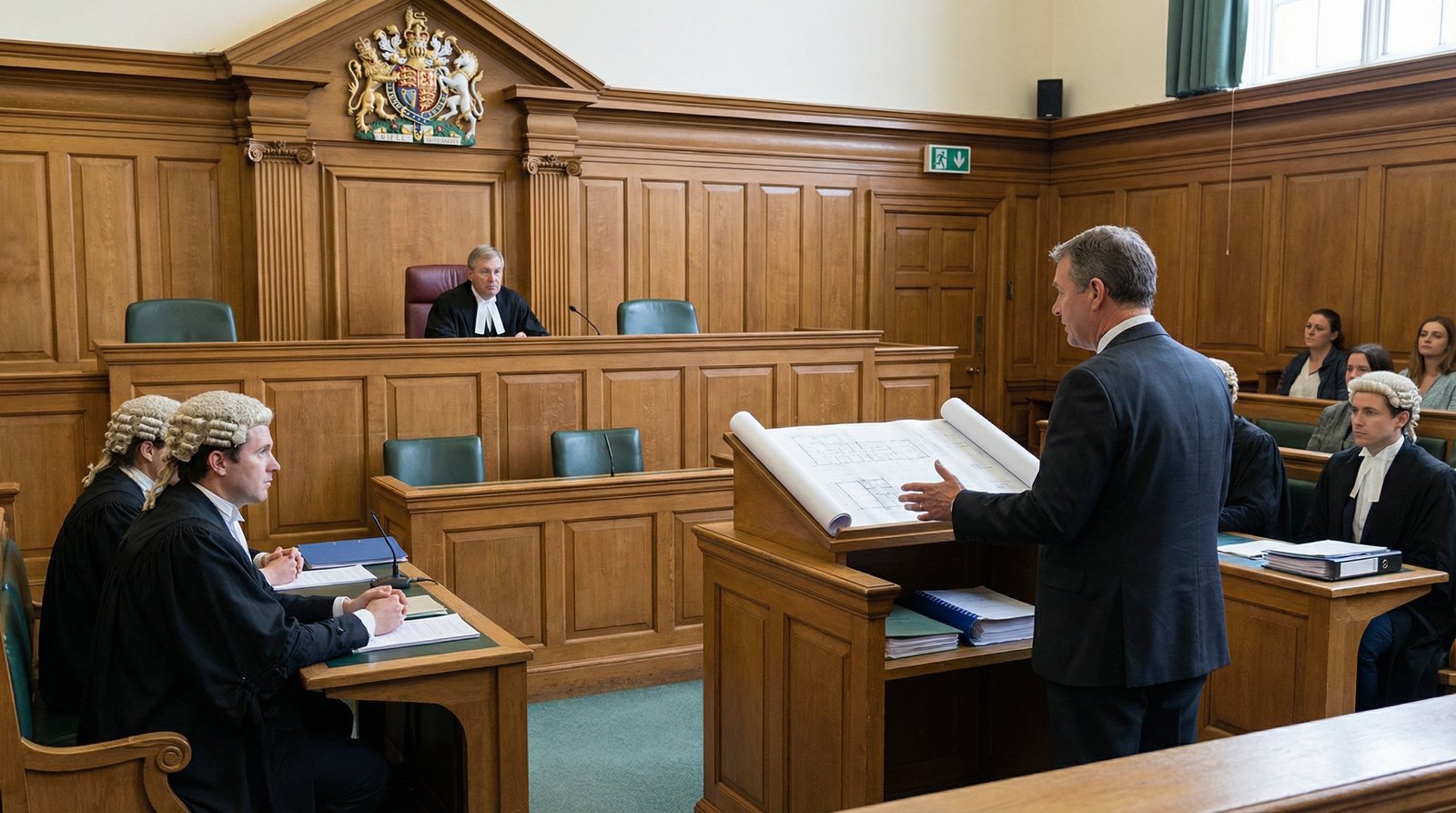
Expert witness evidence plays a crucial role in property disputes, construction litigation, and dilapidations claims. As chartered building surveyors who regularly provide expert witness services, we understand the importance of complying with the Civil Procedure Rules Part 35 (CPR Part 35). This comprehensive guide explains everything solicitors, parties, and expert witnesses need to know about expert witness evidence under CPR Part 35.
What is CPR Part 35?
The Civil Procedure Rules Part 35 governs the use of expert evidence in civil proceedings in England and Wales. Introduced as part of the Woolf Reforms in 1999, CPR Part 35 establishes the framework for expert witness appointments, duties, report requirements, and procedures for giving expert evidence in court.
The fundamental principle of CPR Part 35 is that expert witnesses have an overriding duty to the court that takes precedence over any obligation to the party instructing or paying them. This ensures expert evidence is impartial, objective, and assists the court in reaching fair decisions based on professional expertise.
The Overriding Duty to the Court
CPR 35.3 states: "It is the duty of experts to help the court on matters within their expertise. This duty overrides any obligation to the person from whom experts have received instructions or by whom they are paid."
As expert witness building surveyors, we take this overriding duty extremely seriously. Our professional opinions must be impartial, unbiased, and based solely on our expertise and the facts of the case. This duty means:
Independence and Objectivity
Expert witnesses must provide independent professional opinions regardless of which party instructs them. We cannot act as advocates for the instructing party. Our role is to assist the court by providing objective analysis based on our extensive experience and professional knowledge.
Impartiality
Expert witnesses must not allow their professional opinions to be influenced by the party paying their fees. As chartered building surveyors, we maintain professional independence in all expert witness work, providing the same high standard of objective analysis regardless of who instructs us.
Assistance to the Court
The primary function of expert witnesses is to assist the court in understanding technical matters beyond the knowledge of judges and lay persons. We explain complex building surveying issues clearly, enabling courts to make informed decisions on property disputes, building defects, and construction matters.
When is Expert Evidence Permitted?
CPR 35.1 states that expert evidence shall be restricted to that which is reasonably required to resolve proceedings. Courts will only grant permission for expert evidence when it is necessary, considering:
- Necessity: Whether expert evidence is needed to resolve the issues in dispute
- Proportionality: Whether the cost and time involved in obtaining expert evidence is proportionate to the matters in issue
- Alternatives: Whether disputes can be resolved without expert evidence through other means
In property disputes involving dilapidations claims, building defects, boundary disputes, or construction quality issues, expert witness evidence from chartered building surveyors is usually essential. Our professional expertise helps courts understand complex building surveying matters that require specialist knowledge.
Types of Expert Witness Appointments
CPR Part 35 allows for different types of expert witness appointments depending on case circumstances:
Single Joint Expert (SJE)
A single joint expert is appointed jointly by both parties to provide impartial professional opinions. The court may direct that evidence be given by a single joint expert in appropriate cases, particularly when issues are not complex and proportionality is a concern.
As expert witness building surveyors, we frequently act as single joint experts in dilapidations claims and property dispute cases. Single joint expert appointments offer advantages including:
- Cost savings by instructing one expert instead of two
- Quicker resolution through one impartial opinion
- Reduced likelihood of conflicting expert opinions
- More efficient use of court time
Both parties can provide instructions to single joint experts and ask questions about their reports. If parties disagree with single joint expert opinions, they can apply for permission to instruct their own experts, though courts grant such permission sparingly.
Party-Appointed Expert
Each party instructs their own expert witness to provide independent professional opinions supporting their case. Party-appointed experts are common in complex, high-value disputes where technical issues require detailed analysis from different perspectives.
Party-appointed expert witnesses must still maintain independence and objectivity, fulfilling their overriding duty to the court despite being instructed by one party. Our chartered building surveyors provide party-appointed expert witness services while maintaining strict impartiality and professional integrity.
Court-Appointed Expert
In rare cases, courts may appoint experts directly. This typically occurs when parties cannot agree on expert selection or when independent expert opinion is needed to resolve particularly contentious issues.
Expert Witness Report Requirements
CPR 35.10 and Practice Direction 35 set out detailed requirements for expert witness reports. Our expert witness reports as chartered building surveyors always comply with these requirements, ensuring reports are admissible and assist the court effectively.
Mandatory Content Requirements
Expert witness reports must contain:
1. Details of Expert's Qualifications and Experience: Reports must outline the expert's qualifications, relevant experience, and expertise that enables them to provide professional opinions on the matters in issue. We include details of our RICS chartership, professional accreditations, and extensive experience in building surveying and expert witness work.
2. Statement of Truth: Every expert report must contain a declaration that the expert understands their duty to the court and has complied with that duty. The statement confirms that expert opinions are genuinely held and that the expert has made clear which facts are within their knowledge and which are assumed.
3. Instructions Received: Reports must set out the substance of all material instructions (whether written or oral) on the basis of which the report was written. This includes identifying any documents, photographs, or other materials reviewed. The purpose is ensuring transparency about the basis for expert opinions.
4. Details of Investigations: Expert reports must describe any investigations, examinations, tests, or research undertaken. For building surveying experts, this includes site inspections, measurements taken, moisture readings, photographic records, and any testing conducted.
5. Facts and Assumptions: Reports must clearly distinguish between facts (matters within the expert's own knowledge), facts provided by instructing parties, and assumptions made for the purpose of providing opinions. This clarity is essential for assessing the reliability of expert opinions.
6. Material Considered: All material considered when forming opinions must be identified. For chartered building surveyors, this typically includes lease documents, building plans, specifications, photographs, previous survey reports, and correspondence between parties.
7. Qualifications of Opinions: If expert opinions are not properly researched because of insufficient data or time constraints, this must be clearly stated. Experts must identify any qualifications or limitations on their opinions.
8. Range of Opinion: Where there is a range of expert opinion on matters dealt with in the report, the expert must summarize that range and give reasons for their own opinion. This demonstrates awareness of alternative professional views and provides reasoned justification for the expert's conclusions.
9. Summary of Conclusions: At the end of reports, experts must provide a summary of conclusions reached. This helps courts quickly understand key findings and opinions.
10. Expert Declaration: Reports must contain the mandatory expert declaration: "I confirm that I have made clear which facts and matters referred to in this report are within my own knowledge and which are not. Those that are within my own knowledge I confirm to be true. The opinions I have expressed represent my true and complete professional opinions on the matters to which they refer."
Additional Best Practice Elements
Beyond mandatory requirements, our expert witness reports include:
- Executive summaries for easy comprehension
- Appendices with supporting documents, photographs, and calculations
- Clear explanations of technical terminology
- Professional presentation suitable for court use
- Logical structure facilitating understanding
- Cross-referencing to relevant lease clauses, building regulations, or industry standards
Questions to Expert Witnesses
CPR 35.6 allows parties to put written questions to expert witnesses about their reports. These questions must:
- Be for clarification of the expert report only
- Be sent within 28 days of service of the expert report
- Be proportionate to the issues in dispute
As expert witness building surveyors, we respond to questions promptly and thoroughly. Answers to questions are treated as part of expert reports and must maintain the same standards of objectivity and professionalism.
Questions should seek clarification, not challenge expert opinions or request fundamentally new work. If questions go beyond reasonable clarification, experts can seek court directions.
Discussions Between Expert Witnesses
CPR 35.12 encourages discussions between expert witnesses to identify areas of agreement and disagreement. Courts frequently order expert discussions, particularly when each party has instructed their own expert.
Purpose of Expert Discussions
Expert discussions serve to:
- Identify matters where experts agree
- Clarify and narrow the issues in dispute
- Identify reasons for disagreements
- Reach agreement where possible on previously disputed matters
These discussions are "without prejudice" (meaning they cannot be referred to in court unless experts agree). Discussions enable experts to focus on genuine areas of disagreement and often result in significant cost savings by reducing court time needed.
Joint Statements
Following discussions, experts must prepare joint statements setting out:
- Matters on which experts agree
- Matters on which experts disagree with brief reasons
As chartered building surveyors with extensive expert witness experience, we find that professional discussions frequently achieve agreement on many technical matters, leaving only key issues for court determination. This benefits all parties by reducing costs and focussing litigation on genuine disputes.
Expert Witness Immunity
Expert witnesses enjoy immunity from suit for evidence given in legal proceedings. This immunity extends to reports prepared for court proceedings. The immunity protects expert witnesses from claims by dissatisfied parties, ensuring experts can provide honest, impartial opinions without fear of litigation.
However, this immunity does not protect experts from:
- Professional disciplinary proceedings
- Claims for negligence in accepting instructions or preliminary work
- Wasted costs orders if expert conduct causes unreasonable delay or expense
Instructing Expert Witness Building Surveyors
When instructing expert witness building surveyors, solicitors and parties should consider:
Selecting Appropriate Experts
Choose expert witnesses with:
- Relevant Expertise: RICS chartered surveyors with specific experience in the type of property or issue involved
- Expert Witness Experience: Knowledge of CPR Part 35 requirements and court procedures
- Professional Accreditation: Membership of expert witness organizations (e.g., Academy of Experts, Expert Witness Institute)
- Availability: Capacity to complete work within required timescales
- Suitable Location: Ability to inspect properties and attend court if required
Clear Instructions
Provide expert witnesses with:
- Comprehensive background to the dispute
- All relevant documents (leases, plans, correspondence, photographs)
- Clear questions or issues requiring expert opinion
- Relevant timescales and deadlines
- Budget parameters where appropriate
Understanding Expert's Role
Recognize that expert witnesses:
- Owe their primary duty to the court, not the instructing party
- Must provide objective, impartial professional opinions
- Cannot act as advocates or adjust opinions to favor one party
- May reach conclusions that do not entirely support the instructing party's case
Expert Witness Fees and Costs
Expert witness fees are typically charged on an hourly or daily rate basis. Costs include:
- Initial case review and conflict checks
- Document review and analysis
- Site inspections and investigations
- Report preparation
- Answering questions on reports
- Expert discussions and joint statements
- Court attendance if required
Expert witness fees are recoverable costs in litigation, subject to court assessment and reasonableness principles. As professional expert witness building surveyors, we provide clear fee estimates and keep clients informed of costs incurred throughout cases.
Attending Court as an Expert Witness
If matters proceed to trial, expert witnesses may be required to give oral evidence in court. Our experience as expert witness building surveyors includes regular court attendance, providing oral testimony in a wide range of property disputes.
Expert Witness Testimony
When giving evidence in court, expert witnesses:
- Take the oath or affirm to tell the truth
- Are examined in chief by the instructing party's barrister (if party-appointed)
- Are cross-examined by opposing parties' barristers
- May be re-examined by their instructing party's barrister
- May be asked questions by the judge
Effective expert witness testimony requires:
- Clear communication of complex technical matters
- Maintaining composure under cross-examination
- Consistency with written reports
- Honesty about limitations of knowledge or opinion
- Respect for opposing experts while maintaining professional opinions
Common Expert Witness Issues in Building Surveying Cases
Our experience as expert witness building surveyors covers numerous property dispute types requiring expert evidence:
Dilapidations Claims
Expert opinions on lease obligations, schedules of dilapidations, property condition, repair costs, and diminution in value. Expert witnesses analyze lease covenants, assess compliance, and provide professional opinions on reasonable repair requirements.
Building Defects and Disrepair
Professional assessment of building defects, causes, appropriate remedial work, and repair costs. Expert witnesses investigate defects thoroughly, distinguishing between design defects, construction defects, and maintenance failures.
Boundary Disputes
Expert analysis of boundary positions, interpretation of title plans, consideration of historical evidence, and professional opinions on boundary locations. Chartered building surveyors with expert witness experience assist courts in resolving contentious boundary issues.
Party Wall Disputes
Expert opinions on party wall matters under the Party Wall etc. Act 1996, including assessing damage, determining appropriate awards, and resolving disputes between building owners and adjoining owners.
Valuation Disputes
Professional valuation evidence for litigation, including market valuations, diminution in value, and valuation of building defects' impact on property values.
Professional Standards for Expert Witnesses
As RICS chartered surveyors, we adhere to professional standards including:
RICS Practice Statement on Expert Witness Evidence
The RICS publishes guidance for surveyors providing expert witness services, emphasizing objectivity, integrity, and competence. We ensure full compliance with RICS professional standards in all expert witness work.
Continuing Professional Development
Expert witnesses must maintain current knowledge through continuing professional development. We regularly attend training courses, conferences, and professional development events to ensure our expertise remains current.
Professional Indemnity Insurance
Expert witness building surveyors must maintain appropriate professional indemnity insurance covering expert witness services. This protects clients and ensures professional standards.
Conclusion
Expert witness evidence under CPR Part 35 plays a vital role in property dispute resolution. Understanding the requirements, duties, and procedures for expert witnesses helps solicitors, parties, and experts ensure effective use of expert evidence in civil proceedings.
As chartered building surveyors with extensive expert witness experience, we provide professional, impartial, and comprehensive expert witness services for property disputes, dilapidations claims, building defects, and boundary disputes. Our expert witness reports comply fully with CPR Part 35 requirements, and we pride ourselves on assisting courts through clear, objective professional opinions.
Whether you need a single joint expert, party-appointed expert witness, or advice on instructing expert witnesses for property disputes, our team of experienced chartered building surveyors can help. We combine technical expertise in building surveying with thorough understanding of CPR Part 35 requirements and court procedures.